By Khristian Rueda · 21 May 2026
Irish wine lists still lean too heavily on predictable Rioja. That leaves room for something more precise. Rioja Alavesa gives trade buyers a region with altitude, tension, and a Basque edge that reads as more serious than the generic category shorthand. For a buyer trying to build trust with chefs and sommeliers, this is the kind of origin story that does the work before the first pour. La Dehesa curates that story in English so Irish buyers can see why the subregion matters.
Rioja Alavesa: the context
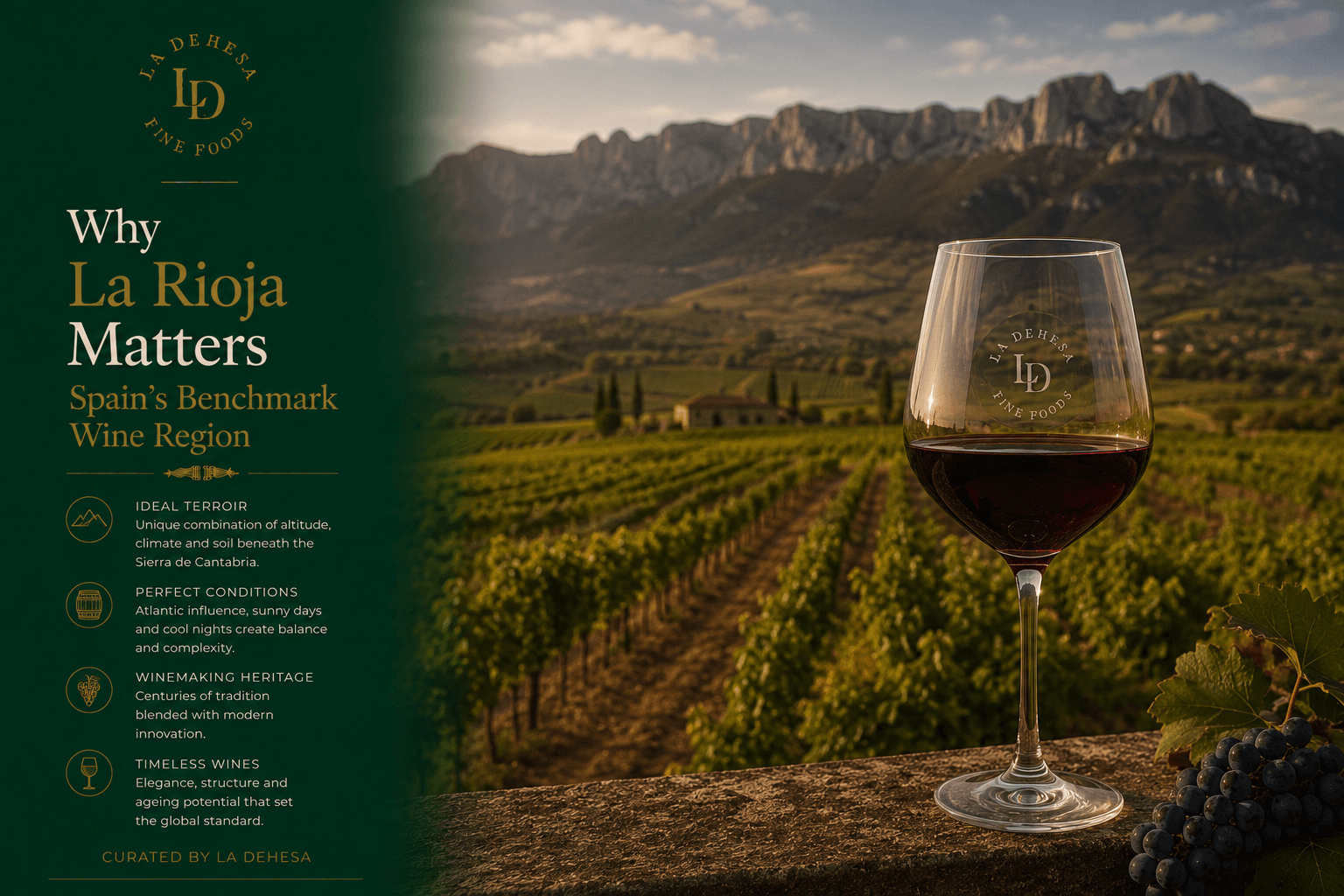
Rioja Alavesa sits on the southern bank of the Ebro, protected by the Sierra de Cantabria and shaped by a meeting point between Atlantic and Mediterranean influence. The vineyards sit higher than many buyers expect, often on limestone and clay soils that force the vines to work harder. That is the first clue to the quality. The grapes ripen under warm days, but the cool nights protect freshness. The result is a profile that can feel lifted, savoury, and more transparent than the broad Rioja stereotype.
This is Basque country in the viticultural sense as much as the political one. The region has a strong food culture, a serious attitude to raw materials, and a long habit of treating wine as something that belongs on the table, not in a marketing brochure. That matters for Irish trade buyers because it means the wines are built for use. They can sit beside grilled vegetables, roast lamb, charcuterie, aged cheese, and seafood with enough shape to hold their own.
Organic and biodynamic farming makes particular sense here. The dry air and good drainage reduce some of the pressure that can force other regions into compromise. Good growers use that advantage to keep yields honest, protect acidity, and let the site speak. When the winemaking is restrained, Rioja Alavesa can show a level of precision that is very useful to a list that wants depth without heaviness. It is not a loud wine region. That is exactly why it deserves a place on better Irish lists.
The producers
The best producers in Rioja Alavesa work with old vines, careful canopy management, and a refusal to over-extract. They harvest by hand when the fruit is ready rather than when a schedule says it should be ready. In the cellar, the choices are often about texture rather than spectacle. Large neutral oak, concrete, amphora, and patient élevage can all be used to preserve the fruit and the shape of the site.
That discipline is why La Dehesa focuses on producers who are willing to let the vineyard do the talking. The trade buyer does not need a complicated technical sales pitch. What they need is a bottle that feels coherent on the list and reliable in service. We source from makers who respect site, balance, and food compatibility. Those are the qualities that matter when the wine has to move in an Irish dining room rather than sit in a cellar with a story nobody remembers.
What This Means for Your Wine List
Rioja Alavesa gives Irish sommeliers a way to move beyond the safe middle of the Rioja category. It can deliver wines that are still recognisably Spanish, but with more lift, more structure, and more regional character. That is useful for by-the-glass programmes, tasting menus, and retail shelves that need one or two bottles to signal seriousness without becoming inaccessible. The wine performs because it is versatile, not because it is trying to be universal.
For buyers, that versatility translates into range management. A restaurant can list one expressive red, one fresher cuvée, and maybe a white or lightly textured wine from the same zone without giving the impression of repetition. The staff story becomes clearer as well. They can speak about limestone, altitude, and organic farming instead of falling back on vague words like smooth or rich. La Dehesa acts as the curator that gives those words shape.
What to look for
Look for subregion detail, organic certification where relevant, and winemaking that preserves freshness. If a wine from Rioja Alavesa tastes too glossy or too sweet, the cellar has probably oversteered it. Better examples will have a savoury line, not just ripe fruit. Ask about vineyard elevation, vine age, and whether the producer works with low intervention or biodynamic practice. Those are useful markers because they usually correlate with better clarity in the glass.
Do not buy Rioja Alavesa just because the name is familiar. Buy it because it gives you something that traditional Rioja does not always deliver at the same level: precision, regional identity, and a cleaner fit with modern food. That is the gap La Dehesa is here to close for Irish buyers.
What to Look for on the Label
Rioja Alavesa is strongest when the list needs a bottle that looks familiar from a distance and more serious up close. That makes it useful for restaurants that want to upgrade the Rioja slot without confusing guests. The subregion detail gives the sommeliers enough material to talk about altitude, limestone, and Basque identity, which is usually all the table needs to hear.
For by-the-glass programmes, the key is freshness and food pull. A wine from Rioja Alavesa should have enough shape to sit beside roast chicken, mushrooms, charcuterie, or grilled vegetables without becoming the loudest thing on the table. If the bottle feels polished but not alive, it will not help the list. The best examples keep the drinker coming back to the glass.
Storage and staff training matter as well. Rioja Alavesa is not a trophy category. It is a working category. That means the wine should be easy to brief, easy to rotate, and easy to recommend under pressure. The region gives you the story. The cellar and service team need to give it a clean landing.
- Use the subregion story to differentiate the list from generic Rioja.
- Prioritise wines with lift and savoury structure over glossy oak.
- Build pairings around food, not tasting-note language alone.
Buyer close
Rioja Alavesa works because it gives a list a point of view. The region says the buyer is looking for something more exact than broad Rioja and more food-led than a generic international red. That is a useful position for any Irish venue that wants to look current without looking complicated.
La Dehesa filters the region so the buyer sees the bottles that matter first. That is the advantage of a curator. It removes the noise and keeps the wines that will earn a place on the list, not just occupy one.
- Choose bottles with energy and shape.
- Let the subregion story do some of the selling.
- Keep the cellar and the floor aligned.
Related reading
La Dehesa supplies Rioja Alavesa wines directly to Irish restaurants and retailers. Request a sample or wholesale price list: hello@ladehesa.com
Trade Enquiries
Get the La Dehesa brochure
Tell us your venue type and receive the current product range.
Browse the full range of Origin Verified Spanish products on the products page, or learn about our sourcing approach on the about page. Find out why Irish hospitality partners choose La Dehesa on why us.
Interested in listing these products at your venue?