By Khristian Rueda · 22 June 2026
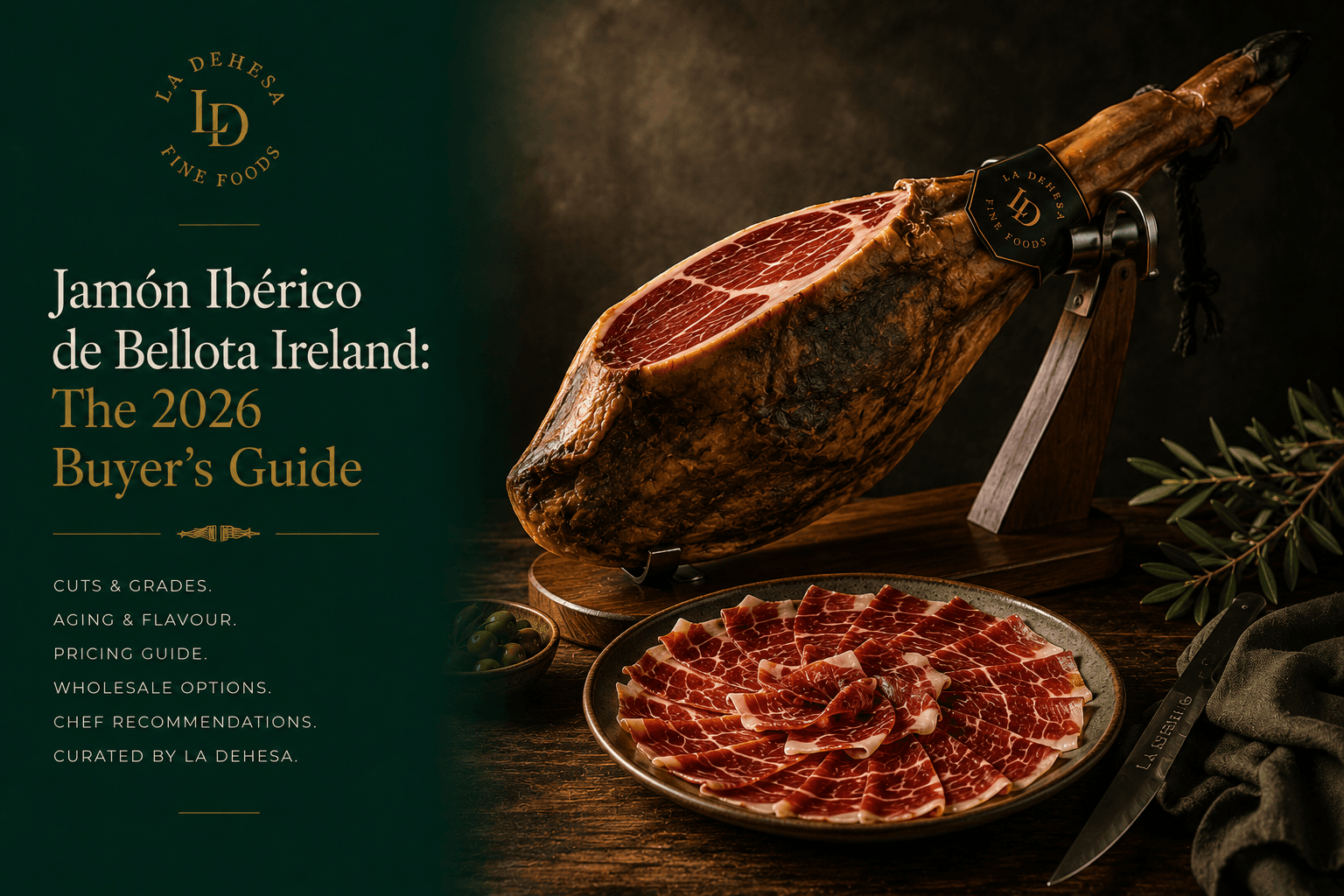
Jamón Ibérico de Bellota is the most prestigious cured meat in Europe, and the most misunderstood at the point of purchase. The category is crowded with overlapping terms, lookalike products, and prices that range from defensible to absurd. For an Irish chef putting acorn-fed Ibérico on a menu in 2026, the difference between buying well and buying badly is not a matter of taste. It is a matter of knowing exactly what the label is required to tell you, and what it is allowed to leave out.
This guide is written for that decision. It covers what Bellota actually means, the grading system you are legally relying on, the specific things to check before you commit, and how to make the cost work on a plate.
What "Bellota" actually guarantees
"Ibérico" refers to the breed: the Iberian pig, a dark-skinned native of the Iberian Peninsula whose physiology lets it marble fat *within* the muscle rather than only around it. That marbling is the entire point. It is why the ham tastes the way it does and why it melts at the temperature of a fingertip.
"De Bellota" refers to the diet and the life. To earn the term, the pigs spend their final fattening phase, the *montanera*, roaming the dehesa, the oak woodland of western Spain, eating acorns, *bellotas*, and wild grasses. The acorn diet does two things: it loads the fat with oleic acid, giving Bellota its glossy, almost olive-oil character, and it can only happen at natural stocking density across a large area, which is why genuine Bellota can never be an industrial product.
So when you read "Jamón Ibérico de Bellota," you are being promised a specific breed, a specific diet, and a specific way of life. The Spanish *Norma de Calidad* governs all three. The job of a buyer is to confirm the label is keeping that promise.
The colour-coded grades you are relying on
Since 2014, Spanish law has required a coloured plastic seal, the *precinto*, on the leg of every Ibérico ham. The colour is the fastest authenticity check you have:
- Black label (negro): 100% Ibérico breed, acorn-fed, free-range. The top of the category. This is what most people picture when they say *pata negra*.
- Red label (rojo): Acorn-fed Bellota, but from cross-bred Ibérico pigs (typically 50–75% Ibérico). Still genuine Bellota, at a lower price than black.
- Green label (verde): *Cebo de campo*, free-range but raised on feed and pasture rather than the acorn *montanera*. Good ham. Not Bellota.
- White label (blanco): *Cebo*, raised on feed, indoors. Entry-level Ibérico.
For a premium Irish menu, you are choosing between black and red. Black gives you the marketing line and the absolute ceiling of flavour. Red gives you most of the experience at a friendlier cost, which can be the smarter call for a by-the-gram charcuterie offer where margin matters.
What to check before you commit
Read the breed percentage, not just the word Ibérico. "Ibérico" can legally describe a pig that is only 50% Iberian. If the story you want to tell your guest is *100% Ibérico*, the label has to say so, and the seal has to be black.
Confirm the curing time. A Bellota leg is typically cured for 36 months or more; shoulders (*paleta*) less. Longer curing concentrates flavour and drives the price. Ask for the months in writing, because "long-cured" on its own means nothing.
Decide between bone-in leg and pre-sliced. A whole bone-in leg gives you theatre, the lowest cost per gram, and a long service life if your team can carve and store it correctly. Pre-sliced, hand-cut packs give you zero waste, instant consistency, and no skilled labour requirement, at a higher cost per gram. Most Irish kitchens without a dedicated *cortador* are better served by quality pre-sliced for à la carte and a leg only when the room and the volume justify it.
Check provenance is named, not implied. "Product of Spain" is not provenance. A named region, a named producer, and a documented method are. If a supplier cannot tell you which *dehesa* the ham came from, you cannot tell your guest.
How to make the cost work on the plate
Bellota is expensive per kilo, but its yield characteristics are generous if you respect them. Served at room temperature in thin, fat-marbled slices, a small portion delivers a disproportionate impression: the fat coats the palate and the flavour lingers, so 25–35g is a complete first-bite experience, not a mean one.
The economics improve further when you build the ham into a format rather than serving it naked. A few slices over warm *pan con tomate*, draped on a croqueta, folded into an aperitivo board with Cantabrian anchovies and Manchego, or carved to order at a wine bar counter all raise the perceived value and the spend per head well above the food cost of the ham itself. The mistake is treating Bellota as a commodity protein costed by weight. It is a centrepiece, and it should be priced like one.
How to serve and store it
Serve at 20–24°C, never fridge-cold. Slice thin, against the grain, with visible marbling in every slice. If you hold a leg, keep it out of direct heat, cover the cut face with its own fat or a cloth, and work through it steadily, a leg loses quality once breached and left.
For pairing, the ham wants acidity and a touch of saline to cut its richness. A Fino or Manzanilla sherry is the classic match. On the wine list, a structured Rioja such as a Tempranillo from Berarte in Rioja Alavesa stands up to the fat without flattening it, and gives a Spanish-coherent by-the-glass option for the board.
The bottom line for Irish buyers
Buy on the seal, the breed percentage, the curing months, and named provenance, in that order. Decide black versus red on the basis of whether you are selling the story or the margin. Choose leg versus pre-sliced on the basis of your team's skill and your volume. Get those four decisions right and Jamón Ibérico de Bellota is one of the highest-impact, best-value centrepieces you can put on an Irish menu.
---
La Dehesa supplies Origin Verified Jamón Ibérico de Bellota from named producers in Extremadura, as whole legs and hand-cut packs, allocated for Irish trade. or message us on and we'll match the grade and format to your service. Explore the page or the full .
---
Sources
- La Dehesa, Jamón Ibérico de Bellota: https://ladehesa.ie/products/jamon-iberico-de-bellota
- La Dehesa, About: https://ladehesa.ie/about
- Berarte Viñedos y Bodegas (Rioja Alavesa): https://berarte.es/en/
Trade Enquiries
Get the La Dehesa brochure
Tell us your venue type and receive the current product range.
Browse the full range of Origin Verified Spanish products on the products page, or learn about our sourcing approach on the about page. Find out why Irish hospitality partners choose La Dehesa on why us.
Interested in listing these products at your venue?