By Khristian Rueda · 22 June 2026
Caviar has one job on an Irish menu: a precise, expensive flourish that has to be plated cold, plated fast, and plated last. It is also one of the most awkward ingredients in the building. It is costly, it is perishable, it bruises if you breathe on it, and the moment it touches heat it collapses. For a kitchen running covers at volume, that is a lot of fragility for a single garnish.
sustainable Spanish caviar was built to solve exactly that problem. It is not sturgeon caviar, and it does not pretend to be. It is something more useful for everyday service: a Spanish-made, heat-stable pearl that delivers the look, the pop, and a clean marine finish without the cost ceiling or the handling risk. For Irish chefs building a provenance-led menu who still need a garnish that survives a busy Friday pass, it is worth understanding properly.
What sustainable Spanish caviar actually is
sustainable Spanish caviar is a Spanish company based in the Region of Murcia, founded in 1983. Its flagship range is Shikrán®: small glossy spheres made by spherification, a technique the company pioneered commercially in Spain in the early 1980s, long before spherification became a fixture of modern gastronomy.
The pearls are built from real ingredients rather than synthetic colour. The core of the range is Mújjol Shikrán®, made from grey mullet roe, with the red version blending mullet roe and smoked herring. Alongside it sit Salmón Shikrán® (smoked salmon), Anchoa Shikrán® (anchovy), and further expressions built on smoked herring and shrimp. Each one carries a distinct marine flavour, a defined colour, and a consistent bead size, so what arrives in the jar is what reaches the plate.
This is the first thing to be clear about with your team: Shikrán is a caviar alternative, not a substitute trying to fool anyone. It is its own category. The roe and seafood bases give it genuine flavour and provenance, and the spherification gives it a uniformity and durability that wild roe simply cannot offer.
Why it's innovative
Three things separate sustainable Spanish caviar from a cheap "caviar-style" garnish, and all three matter in a working kitchen.
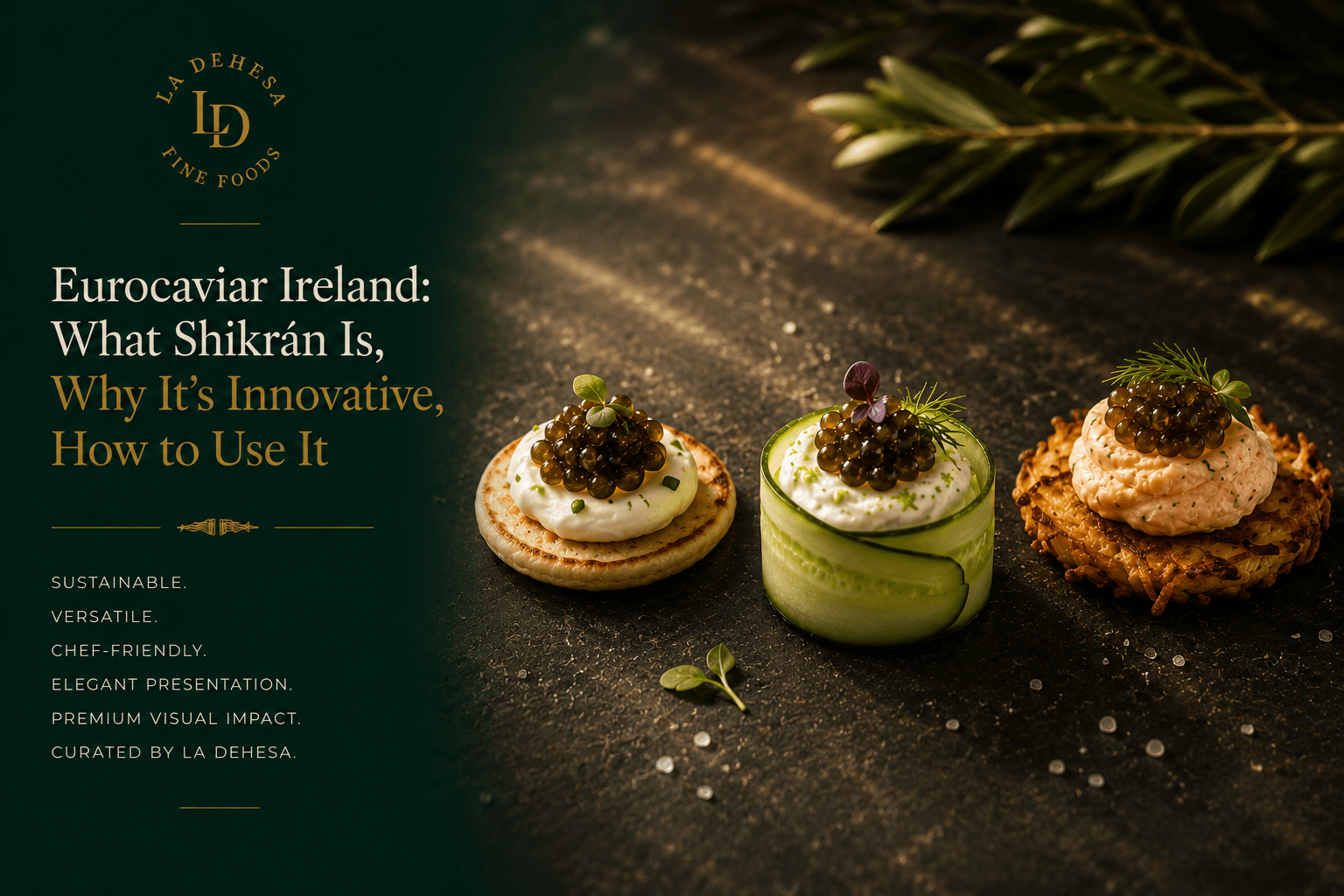
It holds up to heat. This is the headline. Conventional caviar and most fish roe break down the instant they meet a warm plate, a hot pasta, or an oven. Shikrán pearls keep their colour, texture, and taste when baked, grilled, or folded into hot dishes. That single property changes where the ingredient can go on a menu. It is no longer locked to cold canapés. It can finish a risotto, crown a hot croquette, ride on top of a baked oyster, or sit on a warm blini without bleeding or dissolving.
It is built for consistency and shelf life. Wild roe is seasonal, variable batch to batch, and counted in days once opened. Shikrán is produced to strict IFS-certified quality and traceability standards in a facility running to industrial consistency, which means a uniform bead, a predictable colour, and a far longer working window once it is in your fridge. For a kitchen costing every garnish and minimising waste, a product that does not have to be used up in 48 hours is an operational gift.
It is genuinely inclusive. sustainable Spanish caviar holds both kosher and halal certifications, and the range includes gluten-free and, in parts, vegan options built on ingredients like wakame and codium algae rather than fish. For Irish hotels, event caterers, and venues serving mixed dietary requirements at a single sitting, this is the difference between offering one luxury garnish to the whole room and managing three separate ones. The company has also extended spherification beyond roe entirely, into PGI Modena balsamic vinegar pearls, sherry vinegar pearls, and fruit spheres in citrus, mango, and raspberry, which opens the same technique up to dessert and cheese service.
The pedigree is real, too. sustainable Spanish caviar's work has been recognised with the Alimentos de España award and the Innoval prize for its balsamic vinegar pearls, and it now exports to dozens of countries across four continents. This is an established Spanish specialist, not a novelty.
How to use it in Irish service
The value of Shikrán is realised in the places real caviar cannot go. Here is how to brief your floor and your line.
On the cold pass, as you would expect. Blinis with crème fraîche, deviled eggs, oysters, smoked salmon, tartare, and canapé work. The Mújjol black and red pearls give the visual hit of caviar at a price that lets you garnish generously rather than rationing single beads. For wine bars and gastropubs building a Spanish aperitivo offer, a few pearls lift a gilda, a conserva plate, or a bowl of marinated anchovies into something that photographs and sells.
On the hot pass, which is the real unlock. Fold the anchovy or mullet pearls through a finished risotto, or scatter them over hot pasta, and they survive. Crown a warm potato croquette, a baked scallop, or a slice of tortilla at the moment it leaves the kitchen. Because they tolerate heat, you can plate them a beat earlier without watching them weep, which takes pressure off the pass during a rush.
Across the dietary spread. When a table includes halal or kosher guests, or a coeliac, Shikrán lets the kitchen send the same luxury garnish to every cover instead of improvising. For event and banqueting teams plating hundreds of identical canapés, that consistency is the entire point.
Beyond the savoury menu. The balsamic and sherry vinegar pearls finish a cheese board, a burrata, or a tomato salad with acidity and a clean burst, and the fruit spheres bring the same effect to dessert and petit fours. One technique, deployed from the first canapé to the last plate.
A note on positioning, because it matters for how your team talks about it: Shikrán sits alongside true sturgeon caviar, not in place of it. If a tasting menu calls for the real thing, that is a different product and a different conversation. La Dehesa's sustainable Spanish sturgeon caviar covers that brief. sustainable Spanish caviar covers the wide and frequent ground beneath it: everyday luxury garnish, hot-plate applications, and dietary-inclusive service where cost, durability, and certification decide the choice.
Why it fits the La Dehesa range
Everything we bring into Ireland has to pass the same test: a named region, a documented method, and a use case your team can explain in one sentence to a guest. sustainable Spanish caviar clears it. The origin is Spanish and specific. The method, spherification refined over four decades, is documented and certified. And the use case is plain enough to put on a brief: the luxury pop of caviar, on hot or cold plates, for every guest at the table, without the handling risk.
For a kitchen that cares where flavour starts but still has to get plates out at speed, that is a rare combination. It gives your floor team the words, and it gives your line a garnish that works with them rather than against them.
---
sustainable Spanish caviar's Shikrán range is now available for wholesale in Ireland, exclusively through La Dehesa. Run it past your kitchen with a trade sample shaped around your service style. or message us on . Compare it with our and the rest of the .
---
Sources
- sustainable Spanish caviar, Company profile: https://sustainable Spanish caviar.es/en/company/
- sustainable Spanish caviar, Home: https://sustainable Spanish caviar.es/en/
- sustainable Spanish caviar, Mújol Shikrán Selection: https://sustainable Spanish caviar.es/en/mujol-shikran-selection/
- sustainable Spanish caviar Shikrán product listings (Amazon): https://www.amazon.com/sustainable Spanish caviar-Shikran-Mullet-Caviar-Pearls/dp/B088F32W4V
Trade Enquiries
Get the La Dehesa brochure
Tell us your venue type and receive the current product range.
Browse the full range of Origin Verified Spanish products on the products page, or learn about our sourcing approach on the about page. Find out why Irish hospitality partners choose La Dehesa on why us.
Interested in listing these products at your venue?