
By Khristian Rueda · 21 May 2026
Galicia is one of the few seafood regions in Europe where the geography does the branding for you. The rías are not just pretty inlets. They are working estuaries with tidal exchange, nutrient-rich water, and a seafood culture built around traceability, freshness, and preservation. For Irish buyers who need to justify premium conservas to chefs, delis, or retail customers, that matters. La Dehesa curates Galicia as a region with a story buyers can use, not just a list of products.
Galicia Rías: the context
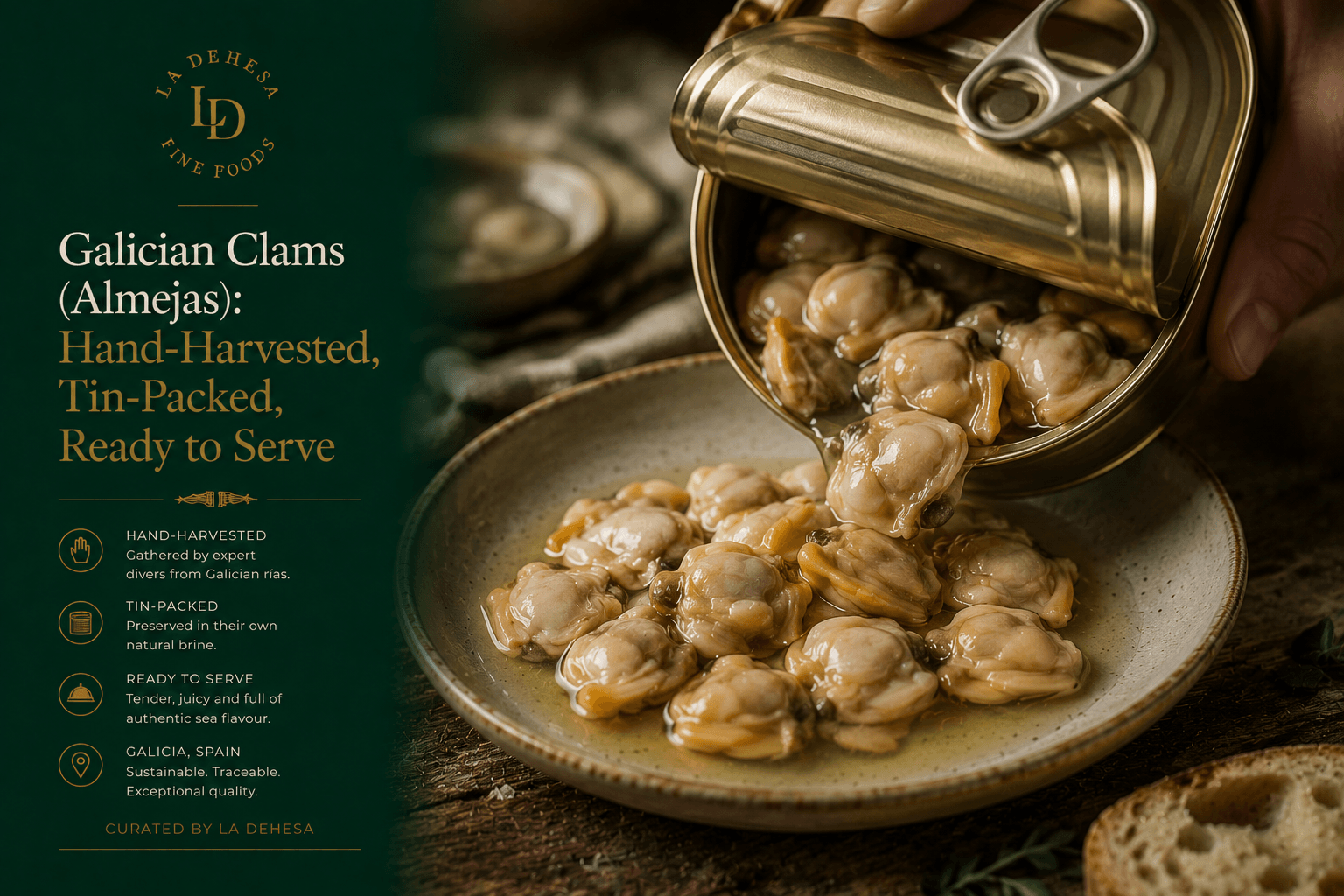
The Galician coastline is cut into a series of rías, drowned river valleys that pull the Atlantic inland and create a unique marine ecosystem. The water is cold, the plankton is abundant, and the tidal movement is strong. That combination supports mussels on ropes, shellfish beds, sardines, cockles, razor clams, octopus, and other seafood that can be preserved without losing its identity. The region is famous for its canning culture because the raw material is good enough to stand up to the process.
This is a place where preservation is not an afterthought. It is part of the food identity. Canning houses, smoke, salt, olive oil, and vinegar have all become part of a regional language that lets the seafood travel without becoming anonymous. A good conserva from Galicia tastes like the sea with the texture still intact. It does not collapse into an indistinct paste or a generic fish spread. That distinction is what turns a tin into a premium product.
For Irish trade buyers, the traceability edge is real. If a customer asks where the shellfish came from, the answer can go beyond Spain. It can point to a specific estuary, a specific tradition, and a specific method of preparation. That is useful for restaurants building trust with guests and for delis that need to explain why one tin deserves more shelf space than another. The region does the heavy lifting when the product is chosen well.
The producers
The best Galician producers are disciplined about sorting, packing, and balance. Seafood may be cooked, steamed, grilled, or preserved in olive oil, escabeche, or brine, but the goal is always the same: keep the structure, keep the flavour clean, and keep the ingredient recognisable. The work is often small-scale and manual. That is not romantic detail. It is a practical reason the product stays premium.
La Dehesa sources conservas from makers who understand that the tin is a finished service item. The point is not to pile on sauce or disguise the raw material. The point is to preserve the marine character so the buyer can build a plate around it. That is why the best seafood conservas from Galicia are so valuable in trade. They behave like ingredients, but they present like finished culinary objects.
Galician Seafood, Built for a Serious Menu
Galician conservas are an easy fit for Irish restaurants, bars, and delis because they solve several problems at once. They are shelf-stable, visually strong, and simple to serve. They allow a venue to put seafood on the menu without the labour and waste associated with live or delicate fresh product. They also give the front of house team a better story to tell. Rather than saying only that something is tinned, the staff can talk about estuaries, tides, and preservation as part of the region’s craft.
Operationally, that matters. A shellfish tin can anchor a seafood board, a vermouth snack, a retail shelf, or a small plate menu without occupying cold prep time. For a buyer, it is a low-risk way to add premium perception. For a chef, it is a way to build flavour quickly. For a deli, it is a format that sells well when the range is curated rather than crowded. La Dehesa keeps that curation tight.
What to look for
Read the label for species, origin, and packing medium. The best tins tell you what the seafood is, where it came from, and how it was preserved. If the label is vague, the product usually is too. Look for firm texture, clean oil, and a finish that still tastes like the Atlantic rather than just salt. Better conservas should feel composed and deliberate when opened.
Seasonality still matters even in a tin. The raw seafood behind the conserve should be harvested at a sensible point, handled quickly, and packed by a producer that knows the difference between convenience and quality. That is what La Dehesa brings to Irish buyers: a regional filter that separates the serious conservas from the generic ones.
How to Choose the Right Tin
Galician seafood conservas are at their best when the buyer understands them as a premium pantry with a service role. They should not sit on the shelf as an afterthought. They should be placed where the customer can see the provenance and understand that the tin has a real culinary purpose, whether that is on a menu, on a deli board, or in a retail gift selection.
For kitchens, the product gives speed. For delis, it gives shelf presence. For bars, it gives a simple route into seafood without building a raw bar. The best part is that the same tin can do all three if the range is curated properly. That is why the estuary story matters. It gives the product enough identity that staff can sell it in one or two lines.
The buying rule is simple. If the seafood looks anonymous, it will sell like a commodity. If the origin, species, and packing style are clear, it becomes something the trade can stand behind. That is the kind of distinction La Dehesa is built to make obvious.
- Ask for species, estuary, and packing medium on the label.
- Use the tin as a finished plate, not a hidden prep ingredient only.
- Keep the range tight so staff can explain it without hesitation.
Buyer close
Galician conservas are easiest to sell when the buyer treats them as a premium service format rather than a backup pantry item. The product looks better, tastes better, and sells better when the estuary story is visible and the team understands why the tin is there.
That is the value of a single access point. La Dehesa narrows the range to the cans that can handle the realities of Irish service and still feel like a proper origin-led purchase.
- Show the origin on the shelf or menu.
- Use the tin as a finished plate.
- Keep the explanation short and specific.
Related reading
La Dehesa supplies Galicia seafood conservas directly to Irish restaurants and retailers. Request a sample or wholesale price list: hello@ladehesa.com
Trade Enquiries
Get the La Dehesa brochure
Tell us your venue type and receive the current product range.
Browse the full range of Origin Verified Spanish products on the products page, or learn about our sourcing approach on the about page. Find out why Irish hospitality partners choose La Dehesa on why us.
Interested in listing these products at your venue?