By Khristian Rueda · 21 May 2026
Cantabrian anchovies look simple only when the work behind them is hidden. For an Irish chef, deli buyer, or bar operator, the real question is not whether the fish are salty. It is whether the origin, the cure, and the pack format give you something that sells itself on the table and stays consistent on the shelf. That is where La Dehesa acts as the English-language gatekeeper: we decode the region, the cure, and the trade logic so you can buy with confidence.
The Cantabrian Sea: the context
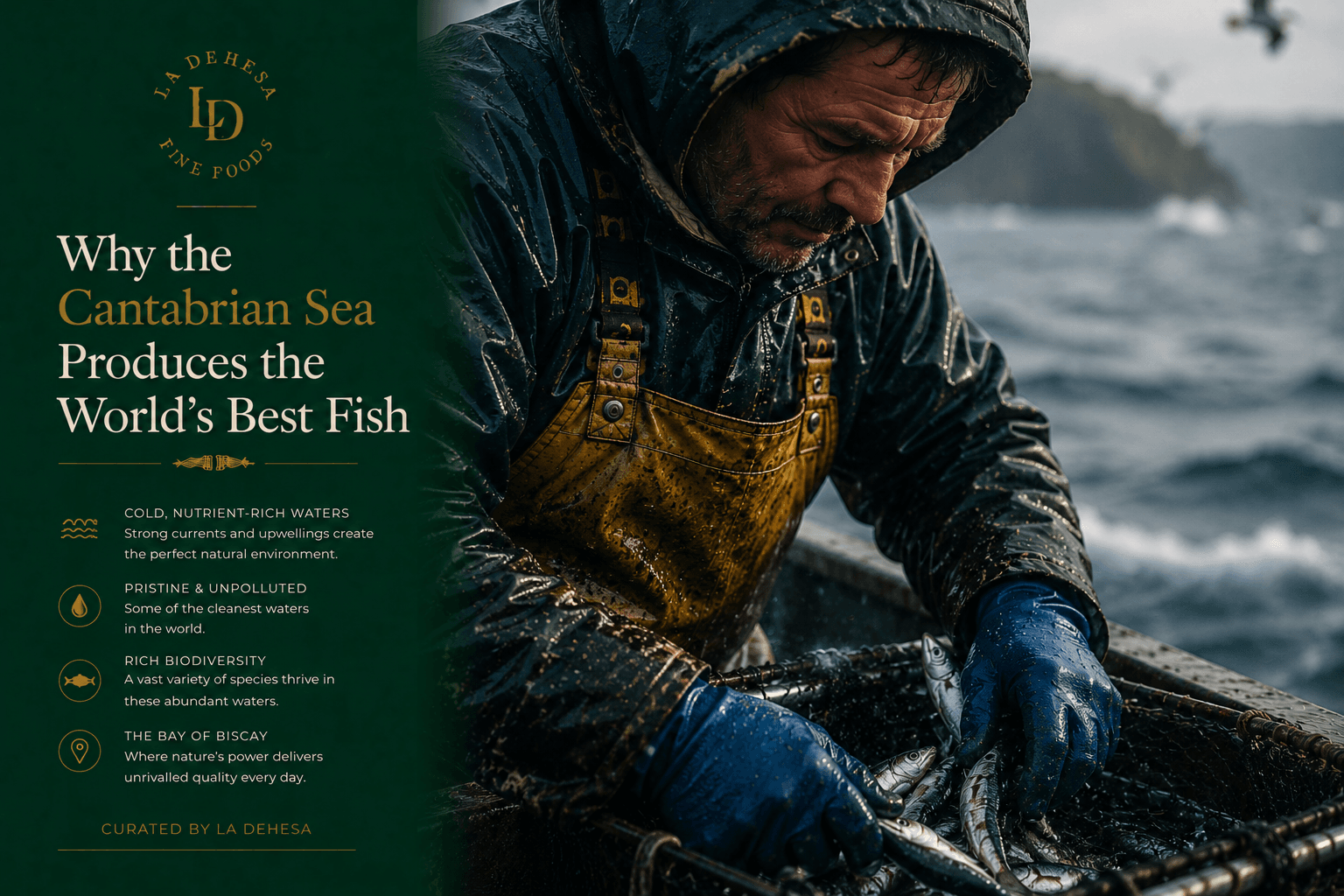
The Cantabrian Sea, the stretch of the Bay of Biscay that feeds the northern Spanish coast, is cold, rough, and rich in plankton. That combination matters. It produces anchovies with a firm structure and a clean, deep flavour before the cure even begins. The waters off Cantabria and the nearby ports of Santoña, Colindres, and Laredo have been tied to anchovy salting for generations because the fish arrive small, oily, and in excellent condition when the season is right.
What the sea gives, the coast preserves. The best anchovies are landed quickly, sorted carefully, and packed in salt while the fish are still at their peak. This is not a generic Mediterranean pantry story. It is a northern Atlantic product with a colder edge, more precision, and a more deliberate cure. That is why the tins and jars from this region taste clean rather than muddy, savoury rather than aggressive, and why they work so well in service where balance matters more than shock value.
For Irish buyers, that distinction is useful. A tapas bar, wine bar, or deli counter does not need an anchovy that simply tastes intense. It needs one that reads as premium the moment it is opened. It needs flesh that holds together, oil that is clean, and salt that supports the rest of the plate rather than taking over. La Dehesa curates for that standard. We look at origin first, then curing, then the way the product will actually behave in trade.
The producers
The canning houses around Santoña and along the Cantabrian coast work in a way that feels old-fashioned for a reason. The fish are cleaned by hand, filleted with patience, and matured in salt before they are packed in olive oil or carefully chosen preserve medium. The craft is in the restraint. If the cure is rushed, the flesh breaks. If the salting is uneven, the result tastes blunt. If the oil is poor, the anchovy loses clarity.
We source from producers who respect that sequence. The point is not to create a heroic story about supply. The point is to choose conservas that have been made with enough discipline to perform in a commercial kitchen or retail display. That means consistent size grading, stable texture, and packaging that travels well. It means a maker understands that an anchovy tin is not a souvenir. It is a service item that has to open cleanly, portion cleanly, and stay elegant from first plate to last.
Why Chefs Choose Cantabrian Anchovies
Anchovies from the Cantabrian coast fit Irish trade in a very direct way. They bring instant aperitivo authority to a small plate, they sit neatly on a tasting board, and they turn a drinks order into a food order without needing a hot pass. In practical terms, they are a low-labour ingredient with high perceived value. A few fillets can frame bread, butter, tomato, peppers, or a simple gilda. They can also anchor a retail shelf because the product explains itself once the buyer knows the origin.
The other advantage is control. A chef can keep a consistent portion. A deli can build a premium conservas range without training staff to the level of a fish counter. A bar can move quickly on a Saturday night and still serve something that feels deliberate. That is the real business case. The anchovy is not just a flavour. It is a proof point that the venue understands quality. La Dehesa brings that proof point into English for Irish buyers who want a single access point rather than a scattered supplier hunt.
What to look for
Read the label for origin first. The Cantabrian coast should be visible. Then look at the cure and the packing medium. Good anchovies are compact, glossy, and intact, with flesh that separates cleanly and does not collapse into oil. The salt should support the fish, not dominate it. The best tins and jars will feel precise, not heavy. If the product looks grey, broken, or over-sauced, it will not perform on a premium menu.
For trade buyers, seasonality matters too. Anchovies are not an all-year commodity in the way a generic pantry item is. The best buying decisions come from choosing the right pack size for service, the right format for the menu, and the right stock rhythm for the pace of the venue. That is the kind of guidance La Dehesa provides. We do the regional reading, then point Irish buyers to the products worth listing.
How to Buy the Right Tin
For Irish buyers, anchovies work best when they are treated as a front-of-house signal rather than a back-of-house ingredient only. The product has to be good enough to be seen, not just cooked with. That means you should choose a format that plates cleanly, keeps its shape, and allows the kitchen or bar team to build a consistent experience from the first service of the week to the last.
The operational question is just as important. If the venue can open a tin, portion it, and send it without a lot of handling, the category becomes easier to repeat. That is why good conservas are so valuable for wine bars and delis. They do not ask for complicated mise en place. They ask for discipline, and they repay it with a product that looks premium with very little labour.
The final check is staff language. A good anchovy programme should give your team a short script: Cantabrian Sea, careful cure, clean olive oil, premium aperitivo use. That is enough. If the origin story gets too long, the table loses focus. If it is too vague, the product loses value. La Dehesa exists to keep that explanation sharp.
- Choose fillets that hold their shape and do not collapse in oil.
- Keep the service story short and consistent across the team.
- Pair with bread, butter, tomato, or a gilda rather than burying the flavour.
Buyer close
The best anchovy programme is the one that becomes part of the venue's rhythm. If the bar team knows when to open it, how to plate it, and which drink it belongs beside, the product stops being a special case and becomes a reliable profit lever. That is why the category rewards curation more than enthusiasm.
La Dehesa keeps the story tight so the buyer can keep the menu tight. The goal is not to list every option on the market. It is to select the packs that will look right, taste right, and move quickly enough to stay fresh in service.
- Keep the offer focused.
- Buy for consistency.
- Use the product where the table can see it.
Related reading
La Dehesa supplies Cantabrian anchovies directly to Irish restaurants and retailers. Request a sample or wholesale price list: hello@ladehesa.com
Trade Enquiries
Get the La Dehesa brochure
Tell us your venue type and receive the current product range.
Browse the full range of Origin Verified Spanish products on the products page, or learn about our sourcing approach on the about page. Find out why Irish hospitality partners choose La Dehesa on why us.
Interested in listing these products at your venue?