
By Khristian Rueda · 22 June 2026
If a Spanish wine offer has one anchor, it is Rioja. It is the region the Irish drinker already half-knows, the name that gives a by-the-glass list instant credibility, and the wine that pairs with almost everything a Spanish kitchen sends out. But "a glass of Rioja" hides a region of real depth, three distinct subzones, a defining grape, and an ageing system that tells you exactly what is in the bottle. Understanding it lets you buy and sell Rioja with authority instead of habit.
The place
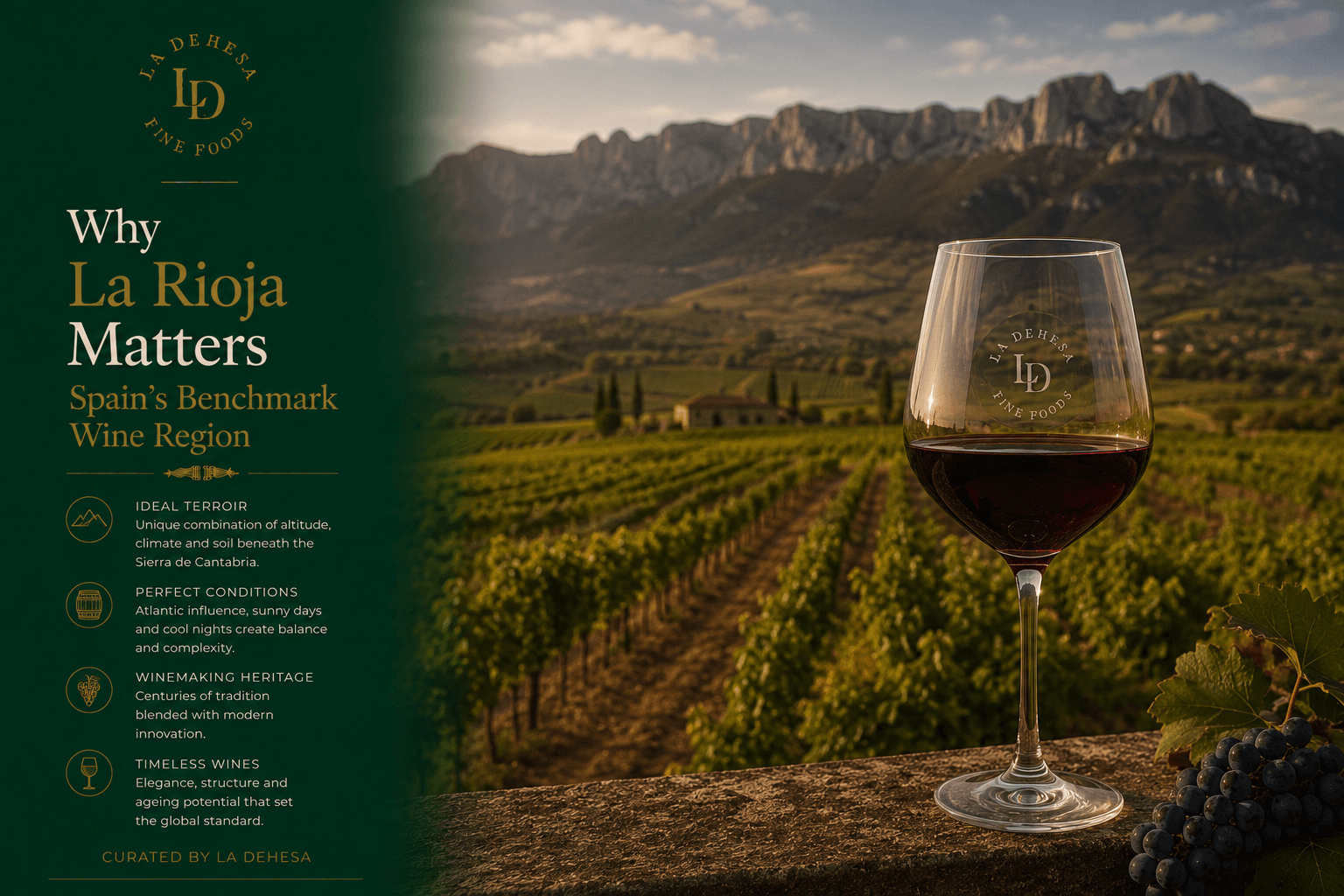
La Rioja sits in northern Spain along the Ebro river, sheltered from the worst of the Atlantic by the Sierra de Cantabria. That shelter, plus a meeting of Atlantic and Mediterranean influences, gives the region a climate built for slow, even ripening. It divides into three official subzones, and the difference between them is worth knowing:
- Rioja Alta, higher elevation, cooler temperatures, limestone and clay soils. The wines are more structured, with higher acidity and tannin, and tend toward elegance and ageing potential.
- Rioja Alavesa, the Basque side, also high and cool, on limestone soils. Wines here show bright acidity and a lifted, refined structure, often the most aromatic of the three. This is the home of small, quality-focused estates.
- Rioja Oriental (renamed from Rioja Baja in 2018), lower, warmer, more Mediterranean. The wines are fruit-forward, rounder, richer, and lusher.
A serious Rioja list usually leans on the cooler Alta and Alavesa zones for structure and food-friendliness.
The people
Rioja's reputation was built by family estates working across generations, and the best of them remain small. Berarte, in Villabuena de Álava in the heart of Rioja Alavesa, is a clear example: a third-generation, family-owned winery farming around 14 hectares of its own vineyards, working organically, and producing a tight range of reds, whites, and a rosé under D.O.Ca. Rioja. This is the human side of the region, growers who farm their own fruit and make wine to a standard, not a volume. Sourcing from estates like this is what separates a considered Rioja listing from a generic one.
The product
Rioja's signature grape is Tempranillo, the red variety that gives the region its backbone: good colour, firm structure, high acidity, and earthy, savoury flavours that develop beautifully with age. It is usually the dominant grape in the blend, often supported by Garnacha, Graciano, and Mazuelo. Rioja also makes serious whites, traditionally from Viura, ranging from fresh and modern to rich and barrel-aged. The reds are the calling card, but a good white Rioja is one of the most useful and underrated wines you can put by the glass.
The concept: reading the ageing ladder
Rioja's genius for a wine list is that the label tells you the style. The classification is based on ageing, and it appears right next to the subzone:
- Genérico / Joven, little or no oak, young and fresh, for early drinking.
- Crianza, aged around two years, with at least one in oak. The everyday workhorse: balanced, food-friendly, by-the-glass gold.
- Reserva, aged around three years, at least one in oak. More depth and complexity, a step up for the list and the table.
- Gran Reserva, aged around five years, at least two in oak and two in bottle. Made only in good vintages. The cellar wine, complex and long-lived.
For your floor team this is a gift: the label communicates both *where* the wine is from and *how* it was raised, so a guest can be guided in one sentence.
The price
Rioja spans the whole range, which is exactly why it anchors a list. A good Crianza offers genuine quality at a by-the-glass price, generous margin and easy sales. Reserva sits comfortably mid-list. Gran Reserva and single-estate organic wines give you the premium, story-led bottles that justify a higher pour. You can build an entire Spanish red offer, from house pour to special occasion, without leaving the region.
The plate
Rioja is built for the food a Spanish kitchen serves. A structured Tempranillo, an Alavesa Crianza or Reserva, stands up to the fat of Jamón Ibérico de Bellota without flattening it, matches grilled and roast meats, and carries heritage beef beautifully. Lighter, younger styles suit charcuterie boards and tapas. A fresh white Rioja or a Rioja rosé bridges to seafood, conservas, and aperitivo plates where a big red would overwhelm. In short, the region gives you a glass for almost everything on the menu.
The bottom line
Rioja matters because it does so much at once: a name guests trust, three subzones offering structure or fruit as you need them, a single great grape, an ageing system that explains itself on the label, and a price range that covers house pour to cellar bottle. Anchor your Spanish list here, source from real estates like Berarte, and brief your team on the subzone-plus-ageing shorthand. It is the most efficient credibility a wine list can buy.
---
La Dehesa brings Origin Verified Spanish wine to Irish hospitality, including organic Rioja from family estates such as Berarte in Rioja Alavesa, to pair with our charcuterie, conservas, and beef. or message us on to build a Spanish list around your menu. Explore the .
---
Sources
- Wine Folly, Rioja wine guide and classification system: https://winefolly.com/deep-dive/rioja-wine-gets-a-new-classification-system/
- Wine Folly, Rioja from Crianza to Gran Reserva: https://winefolly.com/deep-dive/rioja-wine-from-crianza-to-gran-reserva/
- Berarte Viñedos y Bodegas (Rioja Alavesa): https://berarte.es/en/
Trade Enquiries
Get the La Dehesa brochure
Tell us your venue type and receive the current product range.
Browse the full range of Origin Verified Spanish products on the products page, or learn about our sourcing approach on the about page. Find out why Irish hospitality partners choose La Dehesa on why us.
Interested in listing these products at your venue?