By Khristian Rueda · 22 June 2026
Build a Spanish board around two things and you cannot go far wrong: a wedge of Manchego and a few slices of Jamón Ibérico. They are the two most recognisable names in Spanish food, they complement each other on the plate, and together they anchor an aperitivo or wine-bar offer that sells itself. Understanding what each one is, and how to pair them, turns a generic "cheese and ham" plate into a considered Spanish board your floor team can talk about.
Place, Origin Verified
The two come from opposite corners of Spain, and the contrast is part of the appeal. Manchego is DOP-protected cheese from La Mancha, the high, dry central plateau spanning the provinces of Albacete, Ciudad Real, Cuenca, and Toledo. Jamón Ibérico de Bellota comes from the oak *dehesas* of the west, chiefly Extremadura. One is a product of arid plains and hardy sheep; the other of acorn woodland and a native pig. Two landscapes, two crafts, one board.
Product, why each is important and unique
Manchego is made only from the milk of the Manchega sheep, a hardy breed native to La Mancha. That milk is far richer than cow's milk, around 8% fat, which gives Manchego its dense, compact texture and its distinctive tangy, nutty depth. It is graded by age: *semicurado* (semi-cured, roughly 3 weeks to 4 months) is mild, smooth, and buttery; *curado* (3 to 6 months) is firmer and nuttier; and aged *viejo* (a year or more) becomes hard, crystalline, and intensely savoury. One cheese gives you a whole spectrum depending on age.
Jamón Ibérico de Bellota is the acorn-fed, free-range cured ham whose oleic-rich fat melts at room temperature into nutty, glossy richness. Where Manchego brings firm, tangy structure, the ham brings soft, melting, savoury-sweet fat. They are textural and flavour opposites, which is exactly why they work together.
People, who made it
Both are products of guardianship. Manchego depends on shepherds who have protected the ancestral Manchega flock and grazed it across the La Mancha plateau for centuries, and on cheesemakers who age the wheels to a standard. The ham depends on the *dehesa* farmers who raise the Iberian pig on acorns and the curers who tend the legs for three years or more. In both cases you are putting two of Spain's great traditional crafts on one plate.
Plate, how to build the board
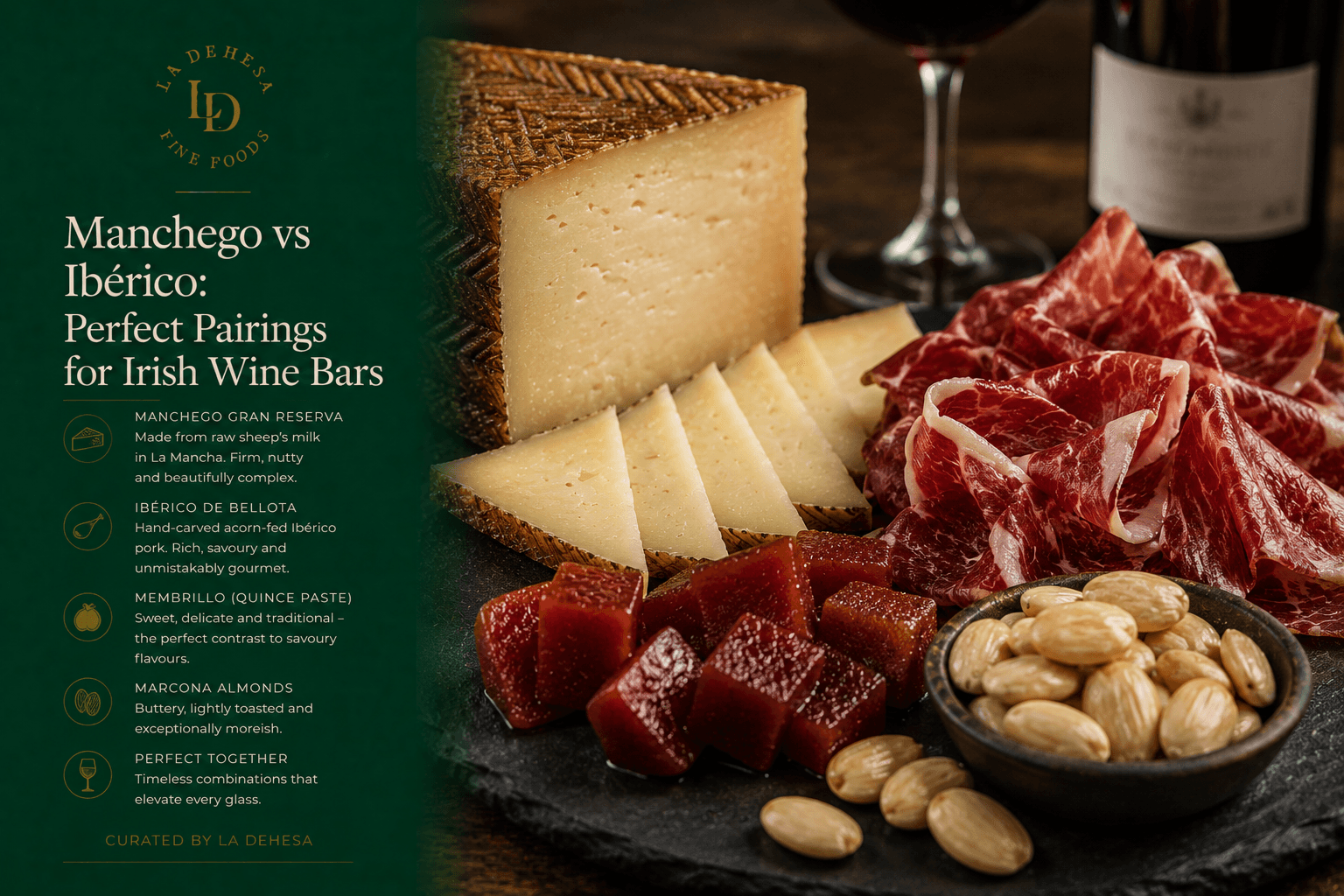
The classic move is to play texture against texture. A slice of melting Ibérico draped beside a firm wedge of *curado* Manchego is the heart of the board. From there, build with the traditional partners that make a Spanish plate sing:
- Manchego with membrillo (quince paste), the sweet-tart jelly against the salty, tangy cheese is the definitive Spanish pairing. Add Marcona almonds for crunch.
- **Ibérico with warm bread or *pan con tomate***, let the fat soften and shine; keep it simple.
- Together, a board of both, with olives, Marcona almonds, membrillo, a few Cantabrian anchovies or a *gilda*, and good bread, is a complete, high-margin Spanish offer that needs no kitchen time.
Serve Manchego at room temperature and the ham at 20–24°C so the fat is soft. Cold kills both.
Value, why it earns its place
This is one of the best-margin offers a wine bar can run. Both products are ambient-stable, need almost no prep, and plate in minutes, yet they read as premium and authentic. A shared Manchego-and-Ibérico board drives drinks sales, encourages lingering, and carries a price well above its food cost. Stock both, brief the team on the age grades and the pairings, and you have a Spanish board that works from the first pour to the last.
The pairings that sell
For wine, keep it Spanish and let the board lead. A structured Rioja Tempranillo (a Crianza or Reserva) is the all-rounder: it stands up to the ham's fat and the aged cheese alike. A crisp Albariño or a dry Txakoli lifts younger Manchego and the anchovies on the board. A Fino or Manzanilla sherry is the classic bar match for both ham and cheese, and a dry Basque cider is a brilliant, lesser-known partner for aged Manchego.
The bottom line
Manchego and Ibérico are not rivals; they are the two halves of a perfect Spanish board, firm tangy cheese against soft melting ham, from opposite ends of Spain. Pair them with membrillo, Marcona almonds, and a glass of Rioja or Fino, and you have an authentic, high-margin, low-labour offer built to sell in any Irish wine bar.
---
La Dehesa supplies Origin Verified Manchego and Jamón Ibérico de Bellota, plus the conservas, almonds, and wine to complete the board, allocated for Irish trade. or message us on to build your Spanish board. Explore the and the .
---
Sources
- KnowTheCheese, Manchego: aging, flavour, and pairings: https://knowthecheese.com/cheeses/manchego/
- Marky's, How Spanish shepherds protect Manchego's ancestral sheep: https://www.markys.com/blog/guardians-of-the-grove-how-spanish-shepherds-protect-manchegos-ancestral-sheep
- La Dehesa, Jamón Ibérico de Bellota: https://ladehesa.ie/products/jamon-iberico-de-bellota
Trade Enquiries
Get the La Dehesa brochure
Tell us your venue type and receive the current product range.
Browse the full range of Origin Verified Spanish products on the products page, or learn about our sourcing approach on the about page. Find out why Irish hospitality partners choose La Dehesa on why us.
Interested in listing these products at your venue?