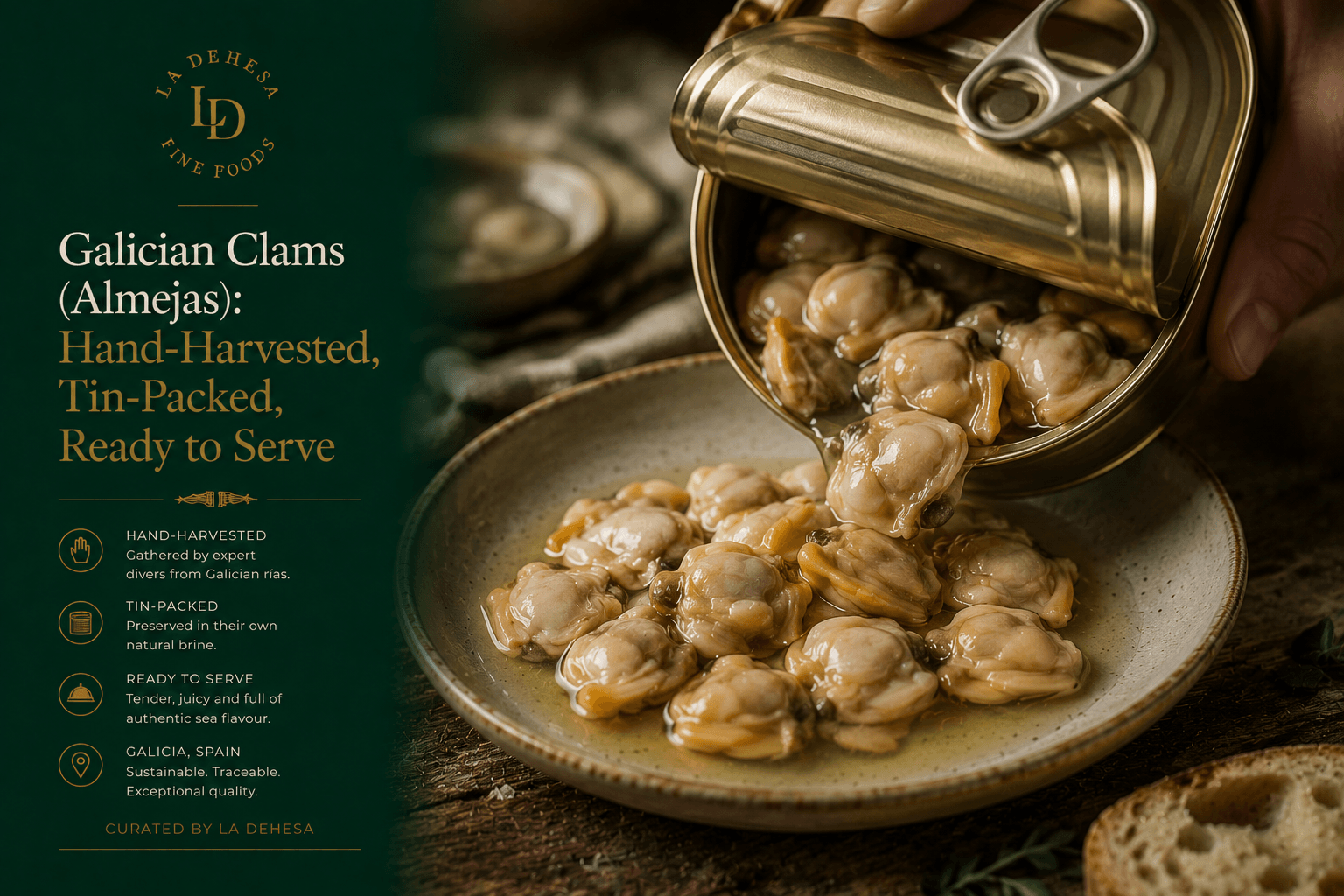
Galician Clams (Almejas) for Irish Kitchens: Hand-Harvested, Tin-Packed, Ready to Serve
By Khristian Rueda · 22 June 2026
In Spain, the best tinned shellfish is not a downgrade from fresh. It is a luxury in its own right, often more expensive than the fresh equivalent and treated with more reverence. Galician *almejas*, clams from the cold Atlantic *rías* of the northwest coast, are the proof. Packed at their peak and served straight from the tin, they give an Irish kitchen restaurant-grade shellfish with no prep, no shells, and no waiting on a delivery of live product. For a busy service, that combination is hard to beat.
Where they come from
The clams are harvested from the *rías* of Galicia, the deep, sheltered tidal estuaries where cold Atlantic water meets nutrient-rich river flow. This is some of the most productive shellfish water in Europe, and the *mariscadoras*, the traditional shellfish gatherers, work the tidal beaches by hand, raking the sand at low tide. The best conservas houses, many of them family-run operations around the Ría de Arousa, take only the largest, plumpest clams for canning.
How they are made
The process is deliberately simple and entirely manual, which is exactly why the quality survives the tin. The clams are cleaned of sand in seawater, cooked gently in seawater, then placed into the tin one by one, by hand, and covered in a light brine. No sauce, no filler, no heavy seasoning to disguise a lesser product. What goes in is clams and the water of the *ría*. A premium tin of *almejas* might hold only a dozen or so large clams, and the count is part of the grade: fewer, bigger clams command a higher price.
Why an Irish kitchen should carry them
Restaurant-grade shellfish, zero prep.A tin of good *almejas* delivers plump, clean, perfectly cooked clams the moment it is opened. No purging, no shucking, no checking which ones opened. For a kitchen that wants shellfish on the menu without the labour and the live-product risk, conservas clams are a quiet operational advantage.
Ambient-stable and waste-free.They keep in the dry store until you need them, then go straight to the plate. No spoilage clock, no mortality in the tank. Every tin you buy is a tin you use.
They read as premium, because they are.Served simply, with their own juice, a dash of good olive oil, a squeeze of lemon, and a little chopped parsley, *almejas* eat as a genuine luxury small plate. Guests who understand Spanish food know that good tinned shellfish is a treat, not a compromise.
How to serve them
The Spanish approach is to do almost nothing. Tip the clams and their liquor onto a plate, finish with extra-virgin olive oil, a crack of pepper, and bread to mop up. That is a complete aperitivo dish.
From there, they slot into service easily: warmed briefly through a garlic, white wine, and parsley sauce for a fast *almejas a la marinera*; folded through the final minute of a seafood rice or a fideuà; spooned over toast with their own brine; or built into a Spanish shellfish board alongside cockles, mussels, and razor clams. The rule is restraint, the clams are the dish, so let them lead and keep the seasoning light enough to taste the *ría*.
Pairing
Galician clams want a crisp, mineral, Atlantic white. The obvious local match is Albariño from Rías Baixas, grown on the same coastline. A dry Txakoli works just as well, and a cold Fino sherry suits the brinier, garlic-driven preparations. Keep it coastal and bright, and the pairing tells the same provenance story as the plate.
The bottom line
Tinned does not mean lesser. Galician *almejas* are hand-harvested from some of Europe's best shellfish water, cooked and packed by hand, and ready to plate as a luxury small dish in under a minute. For an Irish kitchen that wants credible Spanish shellfish without the prep or the live-product gamble, they are one of the smartest items on the order sheet.
---
La Dehesa supplies Origin Verified Galician conservas, hand-harvested clams, cockles, and mussels from the Atlantic rías, allocated for Irish trade.or message us on for a trade sample. Explore the and the .
Tell us your venue type and receive the current product range.
Browse the full range of Origin Verified Spanish products on the products page, or learn about our sourcing approach on the about page. Find out why Irish hospitality partners choose La Dehesa on why us.
Interested in listing these products at your venue?