Why Extremadura's Dehesa System Makes Better Ibérico Ham
By Khristian Rueda · 22 June 2026
You can buy two hams from the same breed of pig, cured for the same length of time, and they will not taste the same. The variable that separates them is not the curing cellar or the salt. It is the land the pig lived on. The finest Jamón Ibérico de Bellota comes from one specific landscape, the dehesa of western Spain, and understanding why is the difference between selling a product and telling a story your guests will remember.
What the dehesa is
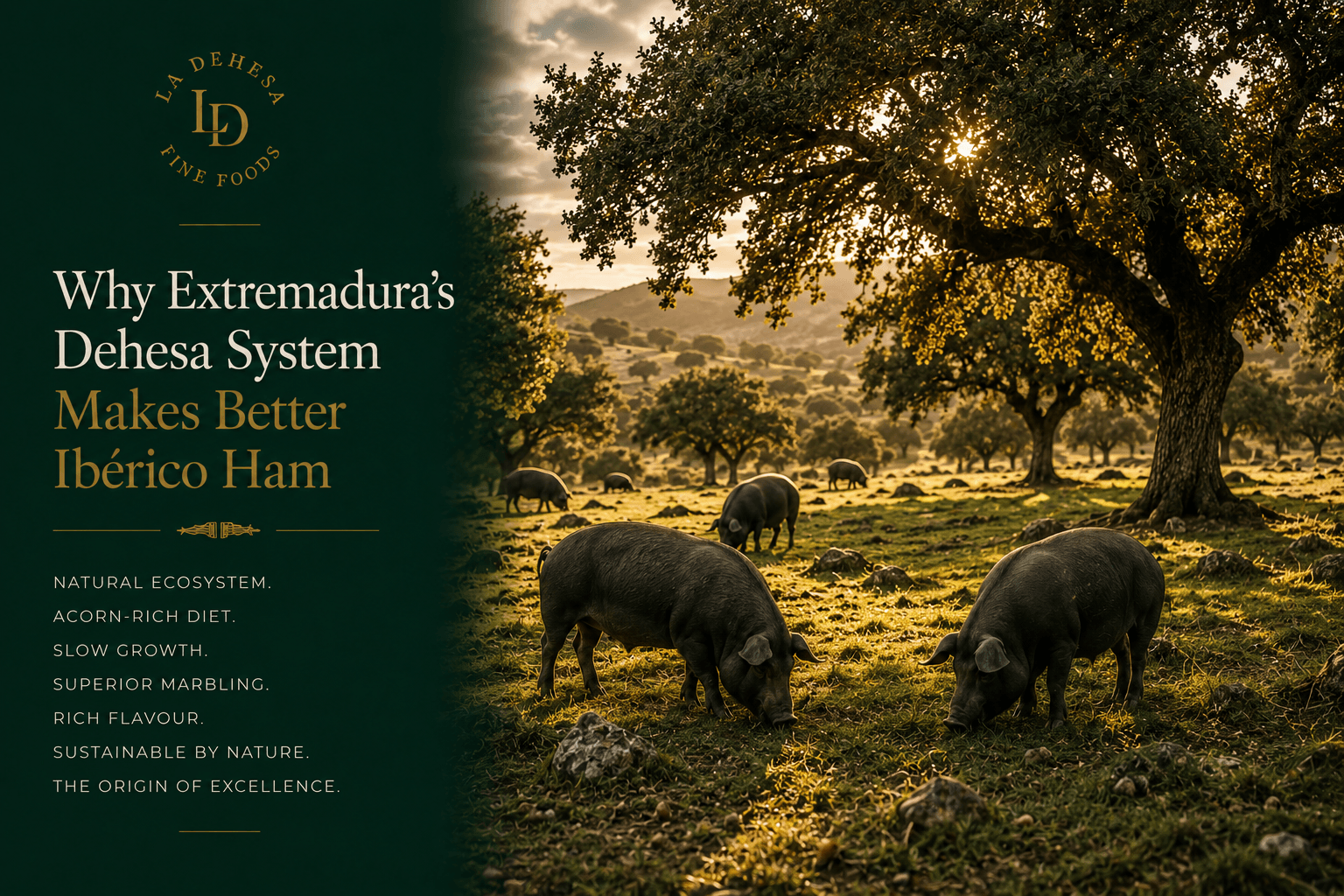
The dehesa is a managed oak woodland that covers large parts of Extremadura and neighbouring regions. It is not wild forest and it is not farmland. It is a centuries-old agro-silvo-pastoral system: widely spaced holm oaks and cork oaks above open pasture, maintained so that trees, grass, and grazing animals coexist on the same ground. The trees produce acorns. The pasture feeds livestock. The animals fertilise the soil and keep the undergrowth down. It is one of Europe's oldest examples of what we would now call regenerative agriculture, and it is the reason the Iberian pig can be raised the way it is.
La Dehesa takes its name from this landscape. It is the origin point of the category.
Why the land changes the ham
Three things happen on the dehesa that cannot be replicated in a barn, and each one shows up on the plate.
The acorn diet rebuilds the fat.During the final fattening phase, the *montanera*, the pigs eat acorns by the kilo. Acorns are rich in oleic acid, the same monounsaturated fat that dominates olive oil. As the pig fattens, that fat is laid down inside the muscle, and its composition shifts toward oleic acid. The result is the glossy, liquid-at-room-temperature fat that defines Bellota, the fat that melts on contact and carries a nutty, almost sweet flavour. A grain-fed pig simply does not produce this.
Space forces slow growth.Genuine Bellota requires low stocking density: roughly one to two pigs per hectare, because each animal needs enough oak territory to fatten on acorns alone. That space means exercise, and exercise means the marbling threads through worked muscle rather than sitting in soft, idle fat. Slow growth over a long life builds depth of flavour that no accelerated system can imitate.
The ecosystem is the quality control.Because the dehesa can only support a limited number of animals, scarcity is built into the model. You cannot industrialise it without destroying the very thing that makes it work. That natural ceiling is why authentic Bellota is genuinely limited, and why the *montanera* season, not a factory schedule, sets the pace of production.
Why this matters to an Irish kitchen
For a menu built on provenance, the dehesa is the most defensible origin story in cured meat. It is specific, it is verifiable, and it connects flavour directly to landscape. When a guest asks why the ham costs what it does, the honest answer is not "because it's premium." It is "because it comes from a pig that spent its last season roaming oak woodland eating acorns, at a density of barely one animal per hectare, and that is what put the marbling and the gloss into the fat." That is a story a floor team can tell with confidence, and it justifies the price without apology.
It is also an ethical-sourcing story, which increasingly matters to Irish diners. The dehesa supports biodiversity, maintains a traditional rural economy, and keeps a centuries-old landscape in working order. A chef who cares where flavour starts is, in this case, also backing a model of land use worth defending.
From the dehesa to the pass
The practical takeaway is simple. When you source Ibérico, source the landscape, not just the leg. Ask whether the ham is genuinely from the *montanera*, whether the breed percentage is stated, and whether the producer and region are named. A ham that can name its dehesa is a ham whose flavour you can explain. One that cannot is a commodity wearing a premium label.
---
La Dehesa sources Jamón Ibérico de Bellota direct from named producers working the oak dehesas of Extremadura, with origin and method documented on every leg.or message us on to taste it in your kitchen. See the page and read .
Tell us your venue type and receive the current product range.
Browse the full range of Origin Verified Spanish products on the products page, or learn about our sourcing approach on the about page. Find out why Irish hospitality partners choose La Dehesa on why us.
Interested in listing these products at your venue?