
By Khristian Rueda · 22 June 2026
When a Spanish chef says an anchovy or a bonito is from the *Cantábrico*, they are not naming a region for the sake of it. They are making a quality claim, and it is one the geography backs up. The Cantabrian Sea, the stretch of Atlantic along Spain's northern coast at the southern edge of the Bay of Biscay, produces seafood that sets the European benchmark. Understanding why turns "Cantabrian" on your menu from a word into a story your team can stand behind.
The place
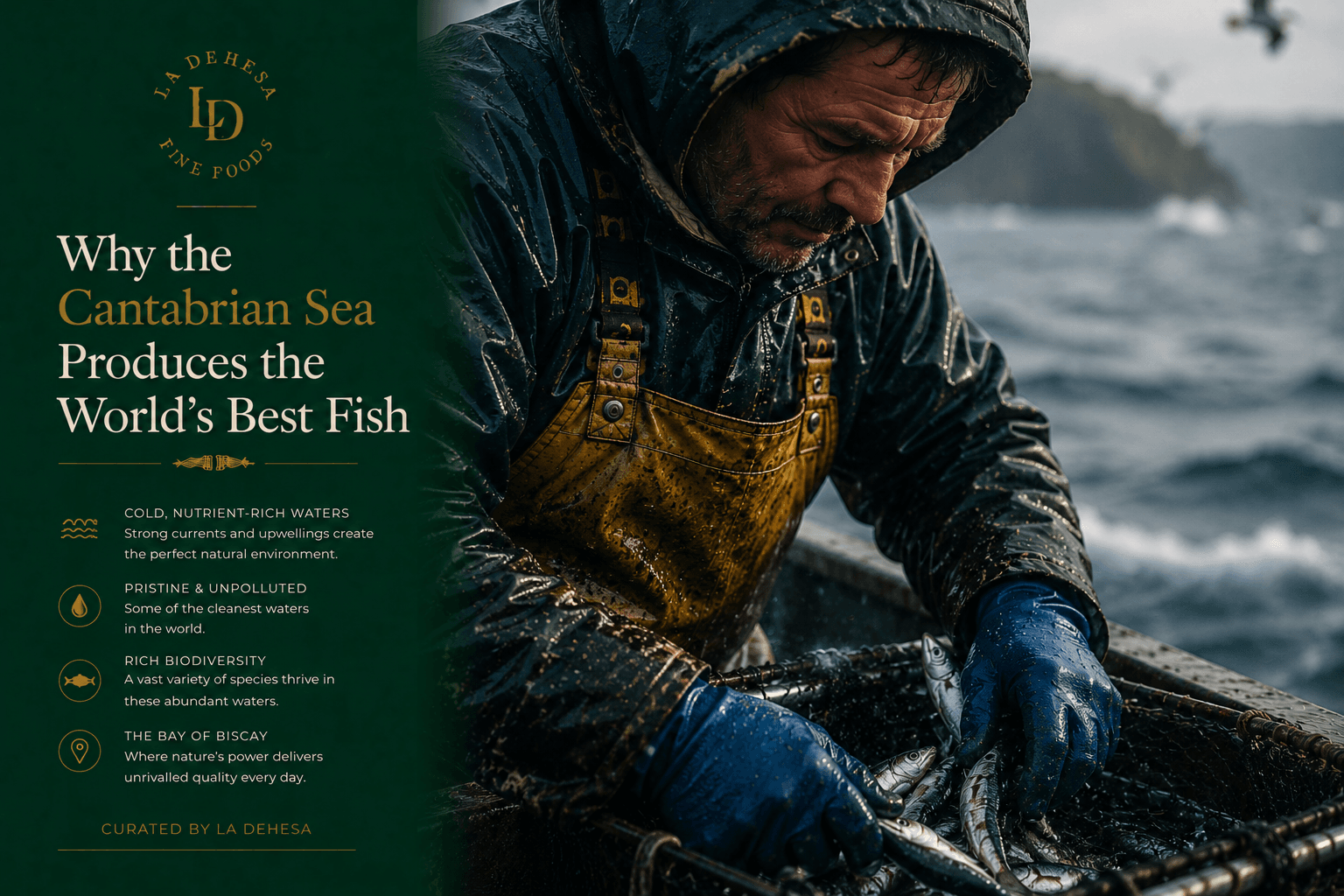
The Cantabrian Sea has a rare combination of physical advantages. It sits over one of Europe's deepest continental margins, with the seafloor plunging past 4,700 metres through dramatic underwater canyons just offshore. That topography, together with cold Atlantic currents, drives seasonal upwelling: cold, nutrient-rich water rises from the deep to the surface, feeding enormous blooms of plankton.
Plankton is the base of the food chain, and this is the engine of the whole thing. The cold, food-dense, restless water means fish here grow more slowly and feed richly. Slow growth in cold water builds firmer flesh, a better fat balance, and more concentrated flavour than warmer, calmer seas can produce. The same principle that makes cold-water shellfish superior applies across the board: the Cantabrian climate is, quite simply, a better place to be a fish.
The people
Geography supplies the raw material; centuries of craft turn it into the finest conservas in the world. The town of Santoña is the global capital of the anchovy, where skilled artisans, the *sobadoras*, hand-clean and hand-fillet each salt-cured fish, a craft that takes years to master and cannot be mechanised. Along the same coast, the *costera* seasons govern the calendar: the spring anchovy run and the summer bonito run, each landed at its peak and packed by family houses who have done it for generations. The product is a marriage of an exceptional sea and the people who know exactly what to do with what it gives them.
The product
Two fish carry the Cantabrian name to the top of the market. The anchovy (*Engraulis encrasicolus*), caught in a fishery that was the first anchovy fishery in Europe to earn MSC certification, hand-filleted and packed in olive oil. And bonito del norte, the albacore tuna caught pole-and-line in summer, whose pale, delicate, perfectly fat-balanced flesh is a world away from a standard tin of tuna. Around them sit the region's hake, mackerel, and other treasures of the same cold water. When the origin is Cantabrian, the fish is the reference standard, not a substitute.
The concept
For an Irish kitchen, the value of all this is a provenance story that is both true and easy to tell. "Cantabrian" is not a flourish; it is a verifiable quality marker grounded in oceanography and craft. It connects the flavour on the plate to a specific cold sea, a specific town, and a specific way of working. That is exactly the kind of origin a provenance-led menu is built on, and exactly the kind of detail that lets a floor team justify a premium with confidence rather than apology.
The price
Cantabrian seafood costs more, and the geography explains why honestly. Slow-grown fish in a demanding sea, caught in regulated seasonal runs, then hand-processed by skilled labour, is never going to be a commodity. But costed against the impression it makes, a single hand-packed anchovy fillet or a few flakes of pole-and-line bonito delivering a complete, memorable bite, it is some of the best-value luxury in the building. You are paying for the sea and the handwork, and both show up on the plate.
The plate
Let the origin lead and keep the cooking restrained. A Cantabrian anchovy belongs on butter and toast or at the heart of a *gilda*, served whole so the guest sees the quality. Bonito wants flaking through a salad, over piquillo peppers, or into a *pintxo*, dressed lightly so its delicate flesh stays the focus. Across the board, the Cantabrian principle holds: the sea has already done the hard work, so the kitchen's job is to get out of the way.
For pairing, the cold Atlantic wants crisp, saline whites and sherries that echo it, Fino, Manzanilla, a sharp Txakoli, keeping the plate and the glass on the same coastline.
The bottom line
The Cantabrian Sea is not a marketing region. It is a genuine geographic and oceanographic advantage, cold, deep, nutrient-rich water that grows the best fish, worked by people who have perfected the craft over generations. Put "Cantabrian" on your menu and you are making a claim the science and the history will back. Source it well, serve it simply, and let your team tell the story.
---
La Dehesa supplies Origin Verified Cantabrian seafood, MSC-certified anchovies, bonito, and the full conservas range, hand-packed on Spain's north coast and allocated for Irish trade. or message us on for a trade sample. See the page and the .
---
Sources
- MSC, Cantabrian Sea purse seine anchovy fishery: https://fisheries.msc.org/en/fisheries/cantabrian-sea-purse-seine-anchovy-fishery/
- The Timeless Tin, The Bay of Biscay: where bonito and anchovies reign: https://thetimelesstin.com/blogs/learn/the-bay-of-biscay-where-bonito-and-anchovies-reign
- La Dehesa, Cantabrian Anchovies: https://ladehesa.ie/products/cantabrian-anchovies
Trade Enquiries
Get the La Dehesa brochure
Tell us your venue type and receive the current product range.
Browse the full range of Origin Verified Spanish products on the products page, or learn about our sourcing approach on the about page. Find out why Irish hospitality partners choose La Dehesa on why us.
Interested in listing these products at your venue?