
By Khristian Rueda · 22 June 2026
Most chefs have only ever met the bad version. The harsh, over-salted, oily anchovy that sits forgotten at the back of the larder and gets used to disappear into a dressing. It has shaped a generation's idea of the fish, and it has nothing to do with what a Cantabrian anchovy actually is. The real thing, hand-cured and hand-packed on the north coast of Spain, is one of the great luxury products in the sea: firm, clean, deeply savoury, and good enough to serve on its own as the first bite of a meal. This is the benchmark, and it deserves to be understood properly.
What makes it the benchmark
The anchovy in question is *Engraulis encrasicolus*, caught in the Cantabrian Sea on the southern edge of the Bay of Biscay. This is the coldest, most productive stretch of water in the region, and the cold is the point: it builds a firmer, fattier, more flavourful fish than warmer waters produce. The spring catch, the *costera*, lands the prime fish, and the town of Santoña is the undisputed global centre of the craft that turns them into the world's finest conserva.
Three things separate this product from everything below it, and all three are worth saying out loud to your team and your guests.
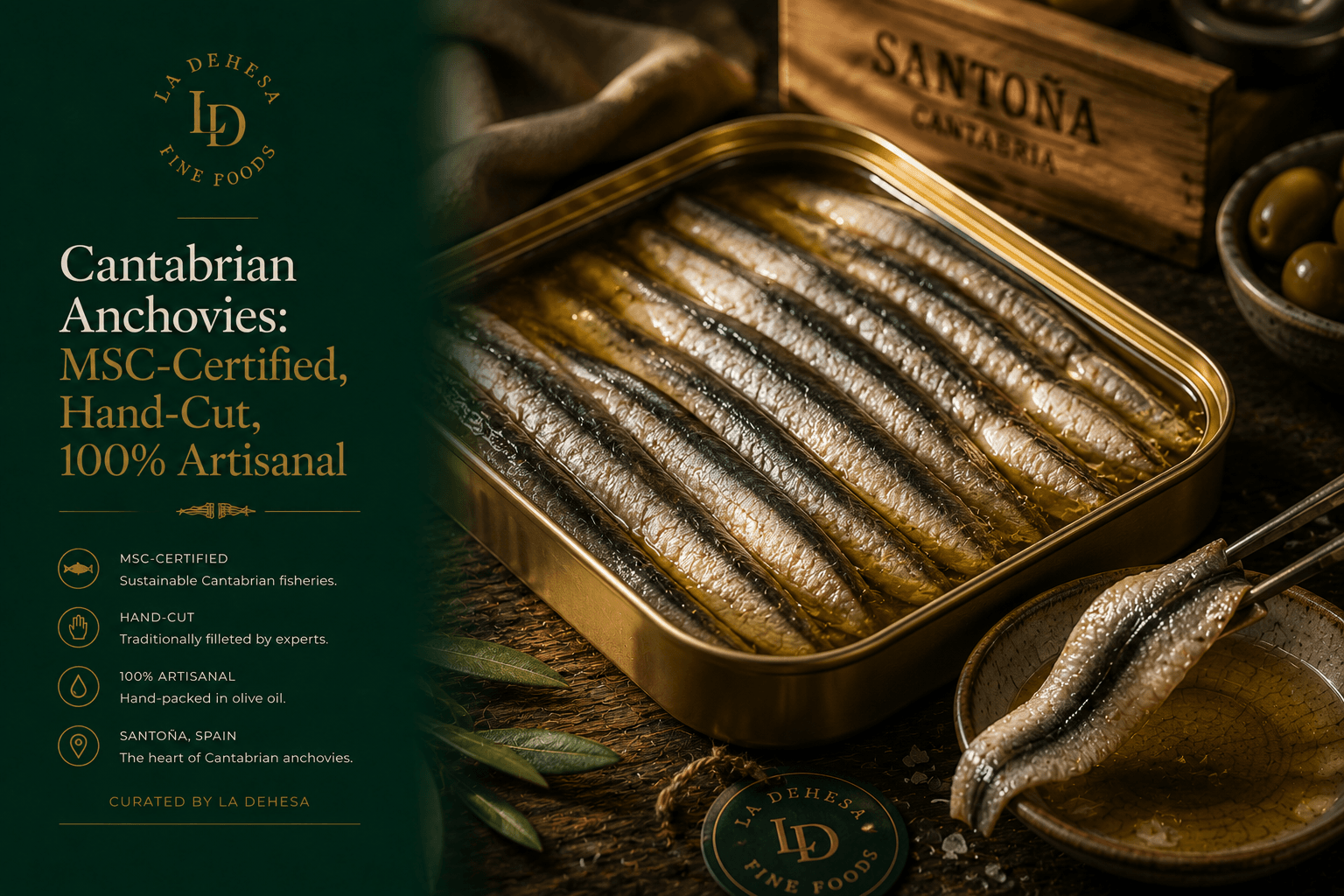
It is MSC-certified. The Cantabrian Sea anchovy fishery was the first anchovy fishery in Europe to earn Marine Stewardship Council certification. That seal certifies two things that matter to a provenance-led kitchen: the stock is fished sustainably, and the supply chain is traceable from catch to tin. For Irish venues whose guests increasingly ask where the fish comes from, that is not a marketing nicety. It is a verifiable answer.
It is hand-filleted by skilled artisans. After the catch, the anchovies are salt-cured slowly, for months, until they mature. Then each fish is cleaned, deboned, and filleted by hand by the *sobadoras*, the expert women of Santoña whose skill defines the trade. There is no machine that can do this without shredding the delicate fillet. The clean, intact, silver-and-rose fillet you see on the plate is the direct result of human handwork, and it is why the best anchovies will always be expensive.
It is 100% artisanal and packed by hand. The matured fillets are laid into the tin or jar by hand and covered in olive oil. Pure fish, salt, time, and oil. No shortcuts, no fillers, no fish sauce harshness. Just patient handwork from boat to tin.
Why it costs what it costs
When a chef baulks at the price of a tin of Santoña anchovies, the honest explanation is the labour. Every fillet has been caught in a certified sustainable fishery, salt-cured for months, then individually hand-cleaned and hand-packed by a skilled worker. You are not buying a commodity fish in oil. You are buying months of curing and a craft that takes years to learn. Costed against the impression it makes on the plate, it is one of the best-value luxury ingredients an Irish kitchen can carry.
How to use it in Irish service
The first rule is the most important: serve the good ones as they are. A premium Cantabrian fillet does not want to be hidden in a sauce. It wants to be the star of a small, simple plate.
On the aperitivo board. A single fillet draped over a slice of cultured butter on toasted bread is one of the great Spanish bar snacks, and it sells. The *gilda*, the classic Basque pintxo of anchovy, olive, and guindilla pepper on a stick, is built around this fish and plates in seconds. For wine bars and gastropubs building a Spanish small-plates offer, the anchovy is a low-effort, high-margin hero.
Plated cold, in 30 seconds. Conservas are ambient-stable until opened, which makes them one of the fastest luxury garnishes in the building. Over a soft-boiled egg, on a tomato salad, with roasted peppers, alongside burrata, draped on *pan con tomate*, the fish does the work and the kitchen barely breaks stride.
As depth, when you want it. The everyday fish still has a place melting into a *bagna càuda*, a puttanesca, a Caesar dressing, or a lamb braise, where it disappears and leaves savouriness behind. Reserve your premium fillets for serving whole, and keep a workhorse grade for cooking.
Pairing
The anchovy wants something crisp and saline beside it. A cold Fino or Manzanilla sherry is the textbook match. From the Basque side, a sharp, slightly spritzy Txakoli cuts the salt and oil beautifully. Both keep the pairing Spanish-coherent and turn a single fillet into a deliberate course.
The bottom line
A Cantabrian anchovy is not a store-cupboard afterthought. It is an MSC-certified, hand-cured, hand-packed luxury product with a verifiable origin and a craft behind every fillet. Treat it like one: serve the best ones plainly, let the fish speak, and give your floor the story. It will outperform almost anything else on the board for the effort it takes to plate.
---
La Dehesa supplies Origin Verified Cantabrian anchovies, MSC-certified, hand-filleted in Santoña, and hand-packed in olive oil, allocated for Irish trade. or message us on for a trade sample. See the page and the built around them.
---
Sources
- MSC, Cantabrian Sea purse seine anchovy fishery: https://fisheries.msc.org/en/fisheries/cantabrian-sea-purse-seine-anchovy-fishery/
- Pujadó Solano, How Santoña anchovies are produced: https://pujadosolano.com/en/production/cantabrian-anchovies/
- La Dehesa, Cantabrian Anchovies: https://ladehesa.ie/products/cantabrian-anchovies
Trade Enquiries
Get the La Dehesa brochure
Tell us your venue type and receive the current product range.
Browse the full range of Origin Verified Spanish products on the products page, or learn about our sourcing approach on the about page. Find out why Irish hospitality partners choose La Dehesa on why us.
Interested in listing these products at your venue?