
By Khristian Rueda · 22 June 2026
Two tins of Cantabrian anchovies can carry the same town on the label, the same olive oil, and wildly different prices. The reason is almost always one thing the casual buyer overlooks: the calibre. Anchovies are graded by size, and size is the single clearest signal of quality and value in the whole category. Once your buying team understands the grading, you stop paying premium money for the wrong tin, and you know exactly what you are putting on the plate.
How anchovies are graded
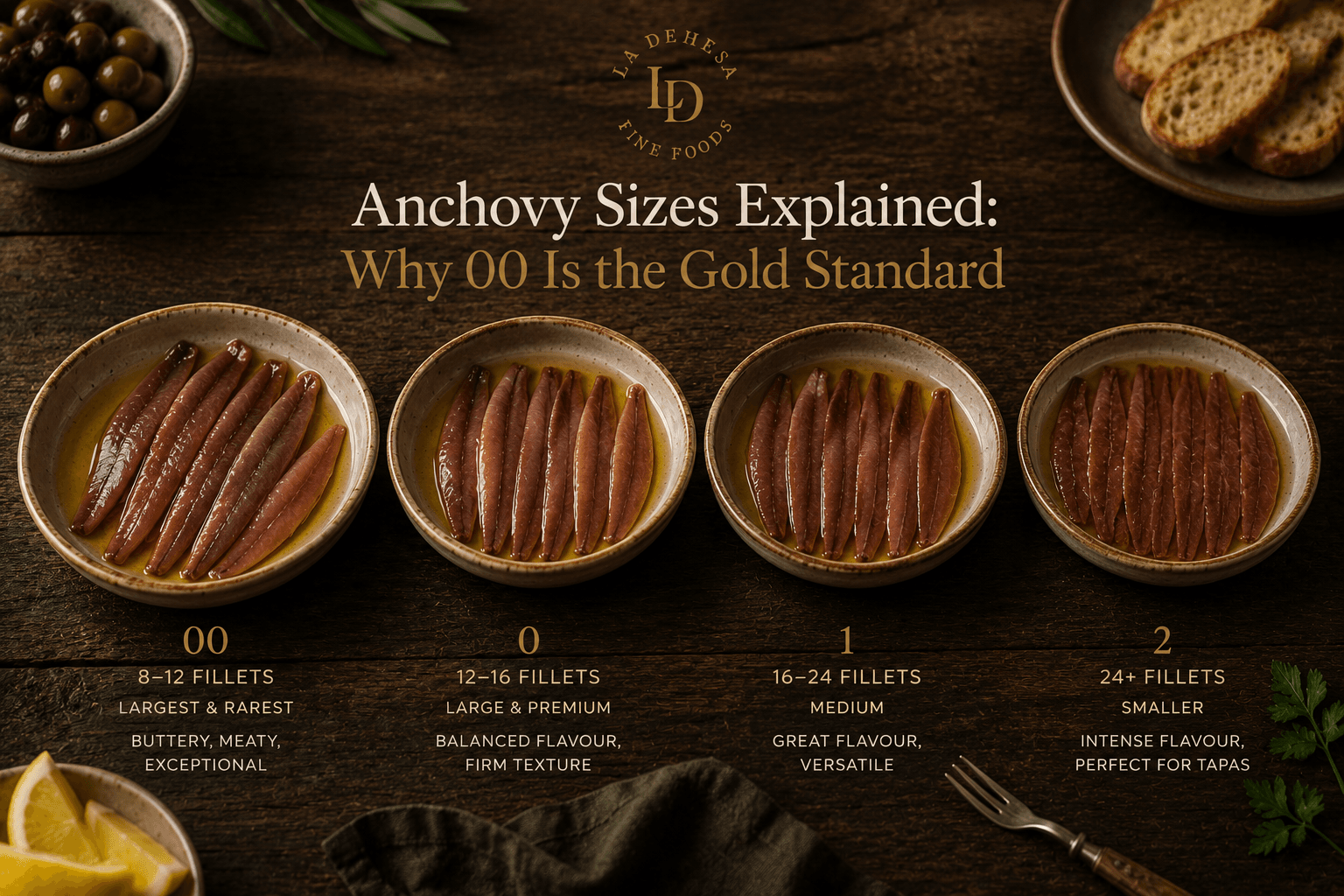
The grade comes down to the size of the fillet, expressed by how many fillets fit in a standard tin. Fewer fillets means each one is larger, which means the fish it came from was bigger, fatter, and rarer. That is the whole logic of the system.
Working from large to small, the calibres you will meet are:
- 000, the very largest fillets, only a handful per tin. Produced in tiny quantities from exceptional fish.
- 00 (double zero), large fillets, roughly 8–10cm, typically around 8–11 in a standard tin. The recognised gold standard of the gourmet market: big, fat, generous fillets, scarce enough to be special but produced in enough quantity to build a menu around.
- 0 (zero), large fillets of roughly 6–8cm. The most in-demand everyday gourmet grade, excellent quality at a friendlier price than 00.
- Smaller grades, more numerous, thinner fillets. Perfectly good for cooking, where the anchovy melts into a dish, but not what you serve whole as a showpiece.
A simple rule for your team: the fewer fillets in the tin, the higher the grade and the price. When you see a count on the label, you can read the quality straight off it.
Why 00 is the gold standard
The 00 occupies the sweet spot. The 000 is magnificent but so scarce and expensive that it is hard to build consistent service around. The 0 is superb value but a notch down in presence. The 00 gives you the best of both: a large, fat, visually impressive fillet with the full melt-in-the-mouth texture of a top-tier anchovy, in enough supply that you can put it on a menu and reorder it reliably.
For the dish where the anchovy is the star, a single fillet on butter and toast, the centre of a *gilda*, draped over a soft egg, the 00 is the grade that justifies the plate. It looks like luxury because it is, and the guest can see the difference before they taste it.
The other half of the grade: the cure
Size is not the only variable. Curing time matters just as much, and the two together define the top of the category.
A standard Cantabrian anchovy is salt-cured for roughly six to twelve months. Gran Reserva (sometimes labelled as a limited or *serie limitada* batch) is cured longer, often 18 to 24 months. The longer cure deepens the flavour and changes the colour: a short-cured fillet is pale, salmon-pink and milder; a long-cured one turns a uniform chestnut brown and tastes rounder, more concentrated, less salty-sharp. That even chestnut colour is itself a quality marker, a sign of a properly matured fillet.
Put the two scales together and the pinnacle of the category is clear: a large 00 calibre fillet, given a long Gran Reserva cure. That is the anchovy you build a signature dish around.
How to buy by grade for your venue
Match the calibre to the job, and you will never over- or under-spend:
Serve-whole, showpiece dishes , buy 00, or 0 for better margin. This is the anchovy the guest sees and remembers. The grade is the point.
Premium aperitivo boards and pintxos , 0 or 00, depending on whether the fillet is the hero or one of several elements.
Cooking, dressings, and depth , use a smaller, more numerous grade. When the anchovy is going to dissolve into a *bagna càuda*, a puttanesca, or a braise, paying 00 prices is wasted money. Keep a workhorse tin for the line and reserve the big fillets for the pass.
Carrying two grades, one premium for serving whole and one everyday for cooking, is how a well-run kitchen gets the best of the fish without blowing the food cost.
The bottom line
Anchovy quality is not a mystery. It is written on the tin as a calibre. Fewer, larger fillets mean a higher grade; 00 is the gold standard for serving whole; and a long Gran Reserva cure is what separates the very best from the merely good. Teach your buyers to read the grade and the curing, and they will buy the right anchovy for the right plate every time.
---
La Dehesa supplies Origin Verified Cantabrian anchovies across calibres, including 00 and Gran Reserva, MSC-certified and hand-packed in Santoña, allocated for Irish trade. or message us on and we'll match the grade to your service. See the page and the .
---
Sources
- Bacalalo, Cantabrian anchovy definitive guide (calibres): https://bacalalo.com/en/blogs/bacalao/anchoas-del-cantabrico-guia-completa-marcas-calibres
- Bacalalo, Anchovy 00 (double zero) guide: https://bacalalo.com/en/blogs/bacalao/anchoa-cantabrico-00-guia
- La Dehesa, Cantabrian Anchovies: https://ladehesa.ie/products/cantabrian-anchovies
Trade Enquiries
Get the La Dehesa brochure
Tell us your venue type and receive the current product range.
Browse the full range of Origin Verified Spanish products on the products page, or learn about our sourcing approach on the about page. Find out why Irish hospitality partners choose La Dehesa on why us.
Interested in listing these products at your venue?